
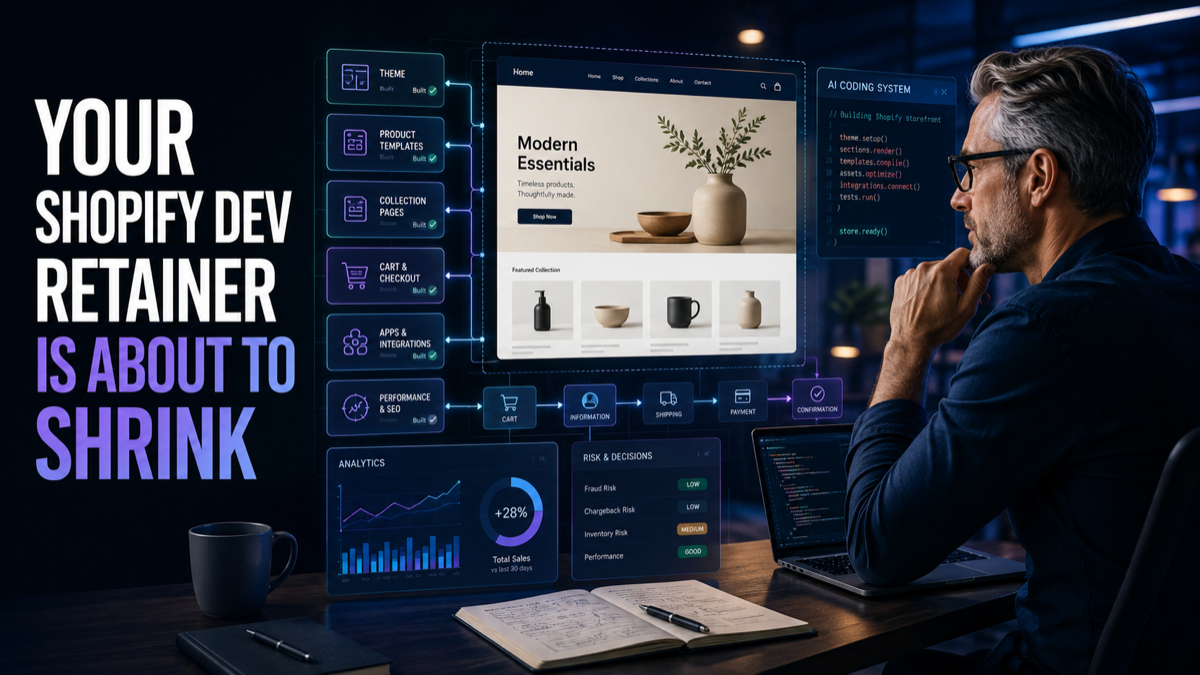
There is a viral argument moving through software circles: AI is “removing the middle class of software engineering.”
The original thesis is more nuanced than “AI will replace developers.” Florian Herrengt argues that AI removes the natural speed limit on producing code. Strong engineers can move faster—but weak decisions can also become thousands of lines of unreviewable complexity before anyone asks whether the system should have been built that way at all.
For ecommerce owners, this is not an abstract debate. It changes what you should expect from the people building your Shopify theme, checkout extensions, apps, integrations, tracking stack, and internal tools.
Here is the practical version:
Routine Shopify implementation is becoming cheaper. Trusted technical judgment is becoming more valuable.
Your development budget may shrink, but cutting it blindly would be a mistake. The smarter move is to stop paying premium rates for repetitive production and redirect that money toward conversion, customer experience, reliable data, security, and experiments that generate measurable business value.
First, the “AI does 80% of the work” claim is not a fact
You will hear confident predictions that AI can now handle 80% of software development. Treat that number as a scenario, not a verified industry benchmark.
The evidence supports a more careful conclusion. GitHub’s coding agents can already research repositories, fix bugs, implement incremental features, improve tests, update documentation, and open pull requests. Shopify now provides an AI Toolkit that connects supported coding assistants to current Shopify documentation, API schemas, code validation, and store-management workflows.
Shopify is also reducing the amount of code needed at the merchant level. Horizon themes can generate custom theme blocks from natural-language prompts, while Sidekick can modify store settings and theme elements through conversation.
But faster code generation does not automatically mean faster, safer delivery. DORA’s research describes AI as an amplifier of an organisation’s existing strengths and weaknesses. Its earlier generative-AI analysis found that increased adoption could coincide with lower delivery throughput and stability when teams allowed larger batches of generated code to overwhelm review and operational discipline.
So the honest answer is not “AI replaces 80% of your developers.” It is:
AI can absorb a large share of routine production, but the percentage depends on the task, the store, the quality of its systems, and the people reviewing the output.
The Shopify work that is becoming cheaper
Many ecommerce retainers are still priced around hours consumed rather than business risk or value created. AI puts pressure on that model because it compresses the time required for predictable tasks.
1. Basic theme changes
Creating sections, adjusting layouts, editing Liquid templates, modifying CSS, adding schema settings, and making responsive fixes are increasingly AI-assisted. Shopify’s own AI block-generation features push some of this work directly into the merchant’s theme editor.
A developer may still need to check accessibility, performance, browser behaviour, theme compatibility, and maintainability. But the raw production time should fall.
2. Repetitive app and integration scaffolding
AI can generate API clients, webhook handlers, GraphQL queries, data mappings, validation logic, test fixtures, and documentation. Shopify’s AI Toolkit can validate GraphQL, Liquid, and extension code against platform-specific schemas, reducing time spent searching documentation or correcting basic platform mistakes.
The integration is not suddenly risk-free. Authentication, retries, rate limits, idempotency, data ownership, failure recovery, and privacy still require deliberate design. Yet merchants should no longer accept the same price for boilerplate that once took days and can now be drafted in hours.
3. QA preparation and routine bug fixing
AI agents can propose test cases, reproduce common issues, inspect logs, write unit tests, and repair contained defects. Humans remain responsible for deciding whether the test coverage reflects real customer journeys and whether a “fix” creates a new commercial or operational problem.
4. Migration and maintenance work
Platform migrations often contain repeatable transformations. In 2026, Shopify demonstrated its AI Toolkit helping developers move checkout and customer-account extensions to newer components. That does not eliminate migration planning, but it can remove substantial mechanical effort.
The same principle applies to dependency updates, code cleanup, documentation, and straightforward technical-debt tickets.
The work store owners will still pay well for
The valuable ecommerce developer is no longer the person who types code fastest. It is the person who can decide what should exist, understand how it affects the business, and prove that it works safely.
Commerce architecture
Should you use an off-the-shelf app, a Shopify Function, a checkout UI extension, a custom app, or no new technology at all? AI can list options. An experienced engineer must evaluate total cost, platform constraints, lock-in, failure modes, and the capabilities of your team.
That decision matters because Shopify checkout customisation operates through governed extension surfaces such as UI extensions, Functions, web pixels, and payment extensions. Shopify Functions can customise backend logic for discounts, delivery options, and cart or checkout validation, but the implementation must respect Shopify’s platform model.
Checkout and revenue-risk decisions
A checkout change can affect conversion, payment acceptance, tax, fraud, discounts, fulfilment, analytics, and customer support at the same time. Generating a checkout component is not the hard part. Understanding the revenue consequences is.
Store owners will continue paying for people who can model those consequences, design rollback plans, monitor releases, and take responsibility when money is on the line.
Integration reliability
Connecting two APIs is easy in a demo. Operating that connection through traffic spikes, partial outages, duplicate webhooks, expired credentials, schema changes, and inconsistent data is engineering.
The premium shifts from “we connected the systems” to “we can prove orders and customer data remain correct when something fails.”
Security, privacy, and compliance
AI can generate insecure code just as efficiently as secure code. Ecommerce systems handle personal data, payments, discounts, accounts, and commercially sensitive information. Threat modelling, permission design, dependency review, audit trails, and incident response remain accountable human work.
Measurement and experimentation
The highest-value ecommerce teams will connect technical changes to a measurable hypothesis. They will define the metric, preserve analytics integrity, control the experiment, interpret the result, and decide what to do next.
AI makes it cheaper to build variants. It does not automatically tell you whether a conversion lift is real, profitable, or caused by broken tracking.
Who is left on the ecommerce development team?
The team becomes smaller at the production layer and stronger at the judgment layer.
| Role | What changes | Why the role remains valuable |
|---|---|---|
| Ecommerce technical lead | Reviews more AI-produced work and writes less routine code | Owns architecture, quality, risk, and trade-offs |
| Shopify specialist | Uses AI to build themes, Functions, apps, and extensions faster | Knows Shopify’s constraints and chooses the right extension surface |
| Conversion/product strategist | Runs more experiments with shorter build cycles | Connects customer behaviour to commercial outcomes |
| Data and analytics engineer | Automates implementation but strengthens validation | Protects attribution, event quality, and decision accuracy |
| Security/reliability specialist | Uses AI for scanning and remediation support | Designs controls and handles failures that affect revenue or trust |
| Junior developer | Produces faster with guidance and learns through review | Builds the future talent pipeline and handles bounded tasks |
The endangered role is not simply “mid-level developer.” It is the person whose value is limited to translating a well-specified ticket into ordinary code without owning the outcome.
That work will not disappear overnight, but it will face aggressive price compression.
What should you do with the budget you save?
Assume your current development retainer falls by 20%, 30%, or even 50%. Do not book the entire reduction as profit before you know why the cost fell. Reinvest a deliberate portion into capabilities that AI makes more valuable.
1. Fund a conversion experiment pipeline
Build a ranked backlog of hypotheses across product pages, merchandising, search, cart, checkout, post-purchase, retention, and customer service. Require every development task to state:
- The customer or business problem.
- The expected measurable effect.
- The minimum viable change.
- The tracking and QA plan.
- The rollback condition.
Cheaper production should produce more learning—not more random features.
2. Fix your data foundation
Audit customer events, consent, channel attribution, server-side tracking, product feeds, order data, and business reporting. If your inputs are unreliable, AI only helps you make incorrect decisions faster.
3. Pay for senior review, not permanent senior typing
You may need fewer developer hours but more concentrated expertise. Buy architecture reviews, security reviews, release oversight, performance audits, and incident readiness. A few hours of strong judgment can prevent months of generated complexity.
4. Improve speed and resilience
Measure storefront performance, app weight, integration failure rates, checkout errors, deployment frequency, recovery time, and escaped defects. AI-created output should pass the same—or stricter—quality gates as human-written output.
5. Invest in proprietary advantage
Do not spend your savings rebuilding commodity features. Invest in systems tied to your unique operations or customer knowledge: smarter merchandising rules, distinctive bundles, better lifecycle personalisation, internal decision tools, or a superior service workflow.
If a competitor can generate the same feature from the same prompt, it is not a durable advantage.
A better way to structure your next Shopify retainer
The traditional retainer sells access to a pool of hours. The AI-era retainer should sell controlled outcomes.
Ask agencies and developers to separate proposals into four layers:
- Commodity production: theme edits, scaffolding, routine fixes, migrations, and documentation.
- Expert decisions: architecture, platform selection, data design, security, and performance.
- Validation: automated tests, manual QA, analytics verification, code review, monitoring, and rollback.
- Commercial outcomes: experiments, conversion improvements, cost reduction, reliability, and customer experience.
Then ask five direct questions:
- Where will AI reduce delivery time, and is that saving reflected in the price?
- Who is accountable for reviewing generated code?
- How will you test platform constraints, security, accessibility, and performance?
- What happens when an integration or release fails?
- Which business metric is this work expected to improve?
An agency should not charge yesterday’s hours for today’s automation. A merchant should not demand bargain pricing while expecting someone else to carry unlimited revenue risk. The fair model prices routine output lower and accountable expertise higher.
The real opportunity for ecommerce owners
AI is not making good ecommerce engineering irrelevant. It is revealing which part of your development bill was buying production and which part was buying judgment.
Production is becoming abundant. Judgment, context, taste, reliability, and accountability are not.
That means the winning store owner will not simply fire the development team or cut every retainer. They will build a leaner relationship with clearer standards:
- Fewer hours spent on boilerplate.
- More senior attention on high-risk decisions.
- Smaller releases that are easier to review.
- Better automated and human testing.
- More experiments tied to customer and profit outcomes.
- Clear ownership when systems fail.
Your Shopify dev retainer may be about to shrink. Good. Use the savings to make the business smarter, faster, safer, and harder to copy.
Final takeaway
The “middle class of software engineering” debate should not make ecommerce owners celebrate layoffs or developers defend inefficient billing. It should force both sides to update the value exchange.
AI will write more of the code. The people worth paying will decide what belongs in the store, what should never ship, how to verify it, and how it contributes to profitable growth.
That is not the end of ecommerce development. It is the end of paying premium prices for implementation without accountability.
Frequently Asked Questions
Will AI replace Shopify developers?
AI is more likely to reduce time spent on routine theme work, scaffolding, tests, documentation, and contained bug fixes than to eliminate Shopify developers completely. Developers who own architecture, security, data quality, checkout risk, and commercial outcomes should remain valuable.
Can AI build a complete Shopify store?
AI can generate theme blocks, content, code, and substantial parts of a storefront. A production store still requires decisions about brand, merchandising, integrations, analytics, performance, accessibility, privacy, security, and operational reliability.
Should I reduce my Shopify development retainer now?
Review it rather than cutting it blindly. Ask which tasks are now AI-assisted, how those efficiencies affect pricing, who reviews generated work, and which measurable outcomes the retainer owns.
What Shopify tasks should remain under human review?
Checkout logic, discounts, payments, customer data, tracking, authentication, integrations, migrations, accessibility, performance, and any change that can affect revenue or trust should receive accountable human review.
What should ecommerce brands reinvest AI savings in?
Prioritise conversion experiments, data quality, security, reliability, performance, customer research, and proprietary systems that create a genuine competitive advantage.