
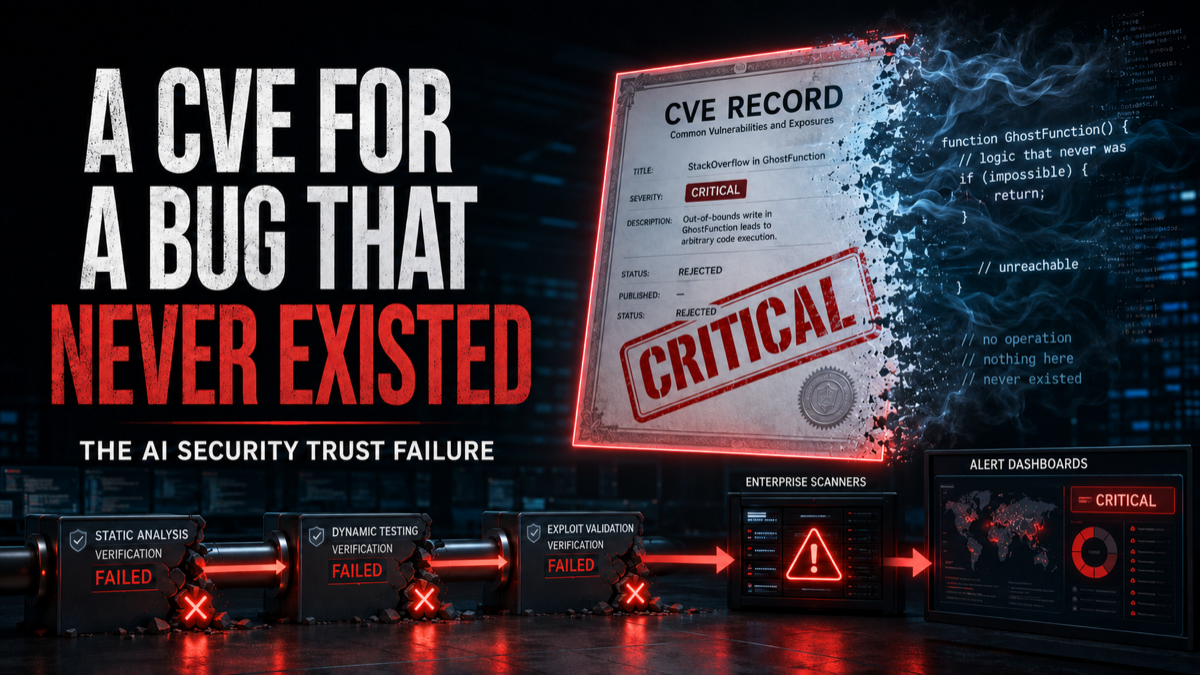
A critical vulnerability was reported in SQLite. It received a CVE identifier, appeared in major security feeds and accumulated severity metadata.
There was one problem: the vulnerable code did not exist in the affected version.
That sentence sounds like the setup for another funny AI hallucination story. It is not funny if you operate an ecommerce platform, ship SaaS software or manage a security backlog.
A CVE identifier is machine-readable authority. It can open tickets, block releases, trigger customer questions, produce compliance findings and send engineers into emergency remediation. When the underlying vulnerability is fictional, the hallucination does not remain inside a chatbot window. It enters the software supply chain.
My opinion is simple: the model may have generated the fiction, but the trust pipeline converted it into operational reality.
That is the part the industry needs to fix.
First, what JFrog actually found
On July 30, 2026, JFrog Security Research published an analysis of six newly published SQLite vulnerability records:
- CVE-2026-51296
- CVE-2026-51297
- CVE-2026-51300
- CVE-2026-51302
- CVE-2026-51303
- CVE-2026-51304
The records described use-after-free vulnerabilities with severity scores ranging from High to Critical. JFrog checked the claims against the relevant SQLite source versions, compiled clean builds in isolated Docker containers and executed the supplied proof-of-concept inputs with AddressSanitizer enabled.
None of the six vulnerabilities reproduced.
The reports failed in ways that should have been immediately disqualifying:
- One cited
exprComputeOperands(), a function that did not exist in the affected SQLite version. - One claimed a fix in SQLite 3.51.3 even though the relevant source file had not changed between the supposedly vulnerable and fixed releases.
- One cited source lines that contained unrelated code.
- One referred to
jsonBlobEdit(), which was introduced after the allegedly affected version. - One referenced line numbers beyond the end of the file.
- One used an incorrect function signature and described a dangling pointer where the implementation explicitly cleared the pointer.
Some PoCs failed during parsing. Others ran normally without a crash, memory error or leak.
SQLite creator Richard Hipp described the reports as fictitious CVEs on the SQLite forum. The records were subsequently rejected after further investigation determined that they were not security issues.
The viral headline needs one correction
“An AI got a CVE for a bug that does not exist” is a strong headline. It is not the full fact pattern.
JFrog found that the advisories appeared machine-generated when analysed with GPTZero, shared repeated structural patterns and contained the kinds of confident technical inventions associated with LLM output. JFrog described them as likely “LLM slop.”
However, an AI detector cannot prove which tool created a document, and the reporter’s exact workflow has not been independently established.
What is verified is this:
| Claim | Fact-check result |
|---|---|
| Six reported SQLite vulnerabilities did not reproduce | Verified by JFrog’s source inspection and isolated testing |
| The records cited nonexistent or unrelated code | Verified in JFrog’s technical analysis |
| The advisories were probably AI-generated | Strongly suspected, but not conclusively proven from the public evidence |
| The reports entered CVE and downstream vulnerability systems | Verified |
| Some records received High or Critical enrichment | Verified |
| The SQLite records were later rejected | Verified |
| A fully autonomous AI personally submitted and obtained them | Not publicly proven |
That distinction matters. I do not need to exaggerate the story to find it alarming.
The serious, defensible conclusion is that plausible-looking but technically false vulnerability reports passed into authoritative systems without mandatory reproduction.
This was not one bad CVE
The six SQLite records were part of a larger collection associated with a newly created GitHub repository. JFrog said it reviewed 55 advisories from the same account and judged 54 to be fabricated; the remaining advisory described a real bug wrapped in unverified CVE metadata.
The additional reports concerned other open-source projects, including LibRaw and ESP32-audioI2S. JFrog’s detailed published reproduction work focused on the six SQLite cases, so those are the strongest basis for conclusions.
This scale changes the story.
One incorrect submission can be a mistake. Dozens of polished, mutually similar advisories demonstrate how inexpensive it has become to generate vulnerability-shaped text—and how expensive it remains to disprove it.
An LLM can invent 50 credible-looking reports quickly. A maintainer or security researcher must still:
- Locate the exact source version.
- Check whether the named functions and lines exist.
- Understand the memory-management path.
- Build the affected release.
- Instrument it correctly.
- Execute the PoC.
- Interpret the result.
- Contact databases and downstream vendors.
The attacker—or careless submitter—pays the cost of generation. The ecosystem pays the cost of verification.
That asymmetry is the real vulnerability.
The three checkpoints that failed
Everyone will dunk on the hallucinating model. I think that lets the rest of the system off too easily.
Three checkpoints should have stopped these claims before they acquired operational authority.
Checkpoint 1: Technical evidence was not required before publication
The first gate should answer a basic question: Does the claimed behaviour exist in the specified version?
For these SQLite records, simple evidence checks would have exposed serious problems:
- Does the function exist in that release?
- Do the referenced line numbers exist?
- Does the PoC parse?
- Does it reach the claimed code path?
- Does a sanitizer detect the alleged memory error?
- Is there a vendor acknowledgement, issue, commit or patch?
According to JFrog, today’s public CVE submission path does not universally require a reproducible PoC or independent reproduction before a record is published. CVE Numbering Authorities often depend on submitters acting in good faith, especially when the CNA does not maintain the affected product.
That honour-based process was built for a world where producing a detailed vulnerability report required meaningful expertise and effort. Generative AI changed the economics without changing the gate.
Checkpoint 2: Enrichment looked like validation
A CVE identifier names a reported issue. A CVSS score estimates severity. A CPE mapping describes affected products. None of these automatically proves the vulnerability exists.
But once a record receives a Critical score, weakness classification and affected-version metadata, it looks increasingly verified to humans and machines.
That creates an authority cascade:
CVE ID → severity score → vendor feed → scanner alert → urgent ticket → emergency change
Every extra field makes the record appear more mature, even if the underlying technical claim remains untested.
The National Vulnerability Database historically provided more manual analysis and enrichment, but NIST has struggled with a large processing backlog since 2024. CISA and other data providers have helped enrich records, but the pipeline remains fragmented. As The Register’s follow-up reporting noted, no universal checkpoint requires every claimed vulnerability to be independently reproduced.
Metadata is useful. Metadata is not evidence.
Checkpoint 3: Downstream automation can act before a human verifies relevance
The third failure is inside our own companies.
Many organisations ingest CVE feeds directly into scanners, risk dashboards, Jira queues, compliance reports and dependency bots. A high score can automatically:
- Create a Priority 1 security ticket
- Fail a CI/CD security gate
- Block a production deployment
- Trigger a dependency upgrade
- Escalate to management or a customer
- Mark a control as noncompliant
- Ask an AI coding agent to generate a patch
Automation is not inherently wrong. The problem is treating an external identifier as a verified instruction.
If an AI remediation agent receives one of these fictional records, it may search for a function that does not exist, modify unrelated code or “fix” a safe component. A false vulnerability can therefore cause a real vulnerability through unnecessary changes.
I would describe that as hallucination laundering: an uncertain machine-generated claim passes through respected databases and emerges looking authoritative enough for another machine to act on it.
Why this matters to ecommerce and SaaS teams
SQLite is extremely widely embedded, but the broader lesson applies to every package in a modern stack.
An ecommerce or SaaS application may contain hundreds or thousands of direct and transitive dependencies across:
- Storefront frameworks
- Mobile applications
- Payment and checkout services
- Search and recommendation tooling
- Analytics SDKs
- Customer-support integrations
- CI runners and developer tools
- Containers and operating-system packages
- Marketplace plugins
Your team does not need to use SQLite as its primary production database for a scanner to discover it somewhere in the estate.
A fictional Critical record can still produce real downstream cost.
False emergency work
Developers stop roadmap work to investigate a supposed critical flaw. Security, platform and product teams join calls. Leadership asks for an exposure statement. Even if the answer is eventually “not vulnerable,” those hours are gone.
Risky emergency upgrades
Under pressure, a team may update a library, base image or framework without its normal regression window. That can break checkout, authentication, inventory sync or order processing—the systems where availability and correctness directly affect revenue.
Release delays
A security gate that treats every Critical CVE as automatically exploitable may block a launch even when the record is false, the package is unreachable or the vulnerable function is absent.
Compliance noise
PCI DSS, SOC 2, ISO 27001 and customer security reviews all create pressure to demonstrate timely vulnerability management. A false record can still appear in exports, evidence packs and questionnaires until it is rejected or manually suppressed.
Alert fatigue
When engineers repeatedly chase irrelevant or false alerts, they become slower to trust the next one. The worst outcome is not one wasted afternoon. It is a security culture trained to dismiss machine-generated warnings.
A sane AI-in-the-loop security workflow
AI should absolutely be used in security. It can summarise advisories, map dependencies, inspect code, generate test cases and help analysts prioritise evidence.
But the system needs three explicit gates.
Gate 1: Validate the advisory
Before a record can drive remediation, verify its identity and technical coherence.
Require:
- Current CVE status: published, disputed or rejected
- Vendor or maintainer acknowledgement
- Correct affected product and version range
- Real functions, files and line references
- Linked issue, commit, patch or advisory where available
- A PoC with enough detail to reproduce
- Consistent weakness and severity metadata
If basic evidence is missing, label the record unverified. Do not silently convert missing evidence into confidence.
Gate 2: Validate your exposure
A real CVE does not automatically create real risk for your application.
Check:
- Is the affected package actually deployed, or only present in development tooling?
- Is the affected version running?
- Is the vulnerable function compiled and reachable?
- Can untrusted input reach it?
- Do configuration, sandboxing or network controls reduce exposure?
- Is exploit activity known?
- What business service would be affected?
Combine the advisory with SBOM, runtime, reachability and asset-criticality data. CVSS should be one input, not the final decision.
Gate 3: Approve the action
AI may recommend a patch, upgrade, mitigation or suppression. A named human should approve actions that can affect production, customer data or availability.
Every recommendation should include:
- Evidence that the vulnerability exists
- Evidence that your environment is exposed
- Proposed change
- Regression and compatibility risks
- Test plan
- Rollback plan
- Decision owner
- Recheck date if the record remains disputed
This follows the same principle as my SAFE framework for AI agents: scope the authority, require approvals, impose hard limits and retain evidence. I explored that model in what happened when GPT-5.6 was allowed to run a real business.
A practical checklist for a new Critical CVE
Before opening an emergency change, ask:
- ☐ Is the CVE still active and not rejected?
- ☐ Has the software maintainer acknowledged it?
- ☐ Is there a real patch, commit or issue?
- ☐ Do the named code symbols exist in the affected version?
- ☐ Has the PoC been reproduced by a credible party?
- ☐ Is our exact package and version deployed?
- ☐ Is the vulnerable path reachable in our configuration?
- ☐ Can untrusted input reach it?
- ☐ Is there evidence of exploitation?
- ☐ What is the business impact if we patch now?
- ☐ What is the business impact if we wait for verification?
- ☐ Is the proposed change tested and reversible?
- ☐ Who owns the final decision?
Security automation should collect these answers, not skip them.
What I would change in an engineering organisation tomorrow
If I were reviewing an ecommerce or SaaS security workflow after this incident, I would make five immediate changes.
1. Add an “evidence state” separate from severity
Use states such as:
- Unverified
- Vendor-confirmed
- Independently reproduced
- Disputed
- Rejected
A record can be Critical and unverified at the same time. Your tooling should be able to express that.
2. Quarantine new high-severity records briefly
Do not automatically suppress them, but do not trigger irreversible remediation solely from the first feed event. Run fast coherence, vendor and reachability checks first.
3. Stop measuring teams only by CVE closure time
If the KPI rewards closing every ticket quickly, teams will produce unnecessary upgrades and meaningless suppressions. Measure verified risk reduction, not identifier throughput.
4. Keep AI in recommendation mode
AI can prepare the investigation, proposed patch and test plan. It should not merge dependency changes or deploy security fixes without defined approval and rollback controls.
This is where an AI governance platform must connect policy to runtime action: who may ask an agent to change code, which evidence is required and which decisions remain human-owned.
5. Record why the decision was made
Store the advisory version, sources, exposure analysis, decision, reviewer and timestamp. If a CVE is later rejected—or a disputed report becomes real—you can reconstruct the reasoning.
My take: the CVE system did not suddenly become useless
The wrong lesson is “never trust CVEs.”
CVE identifiers remain essential for coordinating vulnerability information across vendors, scanners and organisations. The system processes an enormous volume of reports, and early publication can help defenders respond quickly to real threats.
The better lesson is: a CVE is a reference, not a verdict.
The industry has gradually treated identifiers, scores and feed enrichment as interchangeable with verified exploitability. Generative AI exposed the weakness because it can produce security language that satisfies the expected shape without satisfying the technical reality.
The response should not be to ban AI-generated research. AI-assisted fuzzing and code analysis can find genuine vulnerabilities. The response should be evidence-based gates that apply equally to humans and machines.
If a human submits a technically impossible advisory, reject it.
If an AI submits a reproducible vulnerability with correct versions, a working PoC and a verified fix, evaluate it on the evidence.
Trust the artefacts, not the fluency.
The real security bug was authority without verification
These fabricated SQLite records were eventually investigated and rejected. That is the system correcting itself.
But correction happened after the claims had acquired official identifiers, severity data and downstream visibility. In an increasingly agentic development environment, that delay matters.
The next false advisory may not merely waste an analyst’s time. It may instruct another AI to modify production software automatically.
So yes, an apparent AI hallucination made it surprisingly far into the vulnerability ecosystem. But I do not think the most useful response is laughing at the model.
The model produced plausible nonsense. Humans built a pipeline where plausible nonsense could become machine-readable authority.
That is the vulnerability we need to patch.
FAQ
Did an AI definitely create the fake SQLite CVEs?
JFrog found strong indicators of AI generation, including repeated patterns, implausible technical details and AI-detector results. However, the exact authoring tool and level of human involvement have not been conclusively established publicly.
Were the SQLite vulnerabilities real?
JFrog reproduced the relevant SQLite versions in isolated environments and found that none of the six reported vulnerabilities worked. The reports referenced nonexistent functions, impossible line numbers, unrelated code or invalid PoCs. The records were later rejected.
Does receiving a CVE number prove a vulnerability exists?
No. A CVE is a standard identifier for coordinating information about a reported vulnerability. Records can later be disputed, updated or rejected. Teams should verify vendor acknowledgement, technical evidence and their own exposure.
Should companies stop automatically patching Critical CVEs?
Companies should respond quickly, but severity alone should not determine the action. Confirm that the record is valid, the affected version is deployed, the vulnerable path is reachable and the remediation is safer than the current exposure.
Can AI be trusted for vulnerability analysis?
AI can help research, triage and test vulnerabilities, but its output should be treated as a hypothesis until supported by source inspection, reproducible execution and human review. Production changes should remain controlled and reversible.